Day 2 in Ecuador - The Middle of the World & Casa Agave
It was wonderful to crawl into bed last night even if it was at 2:30 AM local time. Ecuador doesn’t recognize daylight savings time so Hallelujah I gained an hour! However, to me it was 3:30 which meant I had been awake over 24 hours. I took a while getting settled with the suitcase shuffle preparing for the day’s activities as toiletries, sunscreen and bug spray were found in my checked bag, camera, visor and daypack in my carryon, and reorganized my pile of money.
ATMs are not prevalent in Quito and non-existent in the Amazon rain forest and the Galápagos Islands we will be visiting. We were told that most merchants do not accept currency over $20 so I brought $1,000 in small bills - $1s, $5s, $10s, and $20s.
Wearing a neck pouch with my passport, COVID and yellow fever vaccine cards along with a stack of currency has created quite a third boob. I wish my natural ones created as large a profile!
The most delicious fruit was on the breakfast buffet - pineapple, cantaloupe, and watermelon, along with some native foods - spinach empanadas and corn tortillas. The ubiquitous eggs, sausages and pancakes were available along with orange and passion fruit juice. I love trying new foods and flavors, but the passion fruit juice was thick and warm. Maybe it was right out of the rainforest but not a winner!
As we traveled to our first destination, our guide told us about life in Quito. This capital city has 3.5 million citizens and is the second largest city in Ecuador. The landscape in Ecuador is surrounded by 85 dormant volcanoes with the last eruption 22 years ago. Quito only suffered damage from volcanic ash which was collected and mixed with soil on farms and public spaces such as parks. Our local guide who has a small family farm said they had a record harvest!
Many residents use the public trolley for transportation. It costs $.35 for 18-64 year olds, and only $.17 for seniors, 6-17 year olds, and people with disabilities. Spanish is the native language, but the original language which is still widely spoken is Quechua. After 2 years of high school Spanish and another two years in college, this will give me a rudimentary chance to practice.
Buenos dias….tarde…noche. Como esta?
That is about it.
The American dollar was accepted as the national currency after the Ecuadorian economic collapse when $1 US equaled $25,000 Ecuadorian money. The minimal wage is $50/month, but most citizens work two or three jobs to earn about $1,000/month. Houses are constructed of cement, blocks, and rebar since wood is expensive. Most people use propane for multiple household uses such as cooking, heating water, and running appliances.
Our first Learning and Discovery stop was the Inti-Non Museum which is the Quechua phrase for “Path of the Sun”. This museum sits exactly on the equator at latitude 0’0’0’ and is called “The Middle of the World”!
Even though the equator passes through multiple countries as it circles the globe, Ecuador is at the highest elevation at over 9,000’, and therefore, the closest spot on the equator to the sun!
Our guide presented cultural facts about ancient people who believed a wife should be buried with her husband when he died. She was given a dose of peyote to drug her and keep her calm as she was sealed into a stone tomb where she later died from asphyxiation…just to keep her husband from being lonely in death!
We engaged in multiple experiments to demonstrate the equatorial effect with water spinning in different direction whether it was placed north or south, even by a few feet, of the red line designating the equator.
We tried to position an egg on the top of a large flat-headed nail which our guide accomplished with ease. She explained that the yolk will settle completely in the center at the equator, and with extremely steady hands the egg can be balanced. I was determined to accomplish this, but I didn’t want to hold up the group with my stubbornness so I handed over the egg to a fellow traveler without achieving success. I bet those eggs boiled on the equator would make perfectly shaped deviled eggs!
Various ancient sundials were explained to us, and my admiration for these cultures was immense. On the equator, the sun’s shadow shone in the northern quadrants September to March and in the lower quadrants the following six months helping to determine times to plant and harvest. Various star constellations were also on the sundials corresponding to when they would be visible in the Southern Hemisphere’s sky.
Strangely and without explanation there were also multiple sculptures created out of various materials repurposed. Interesting, but not sure how it relates to being at the Middle of the World.
N
Our next stop to Learn and Discover was going to make for a FUN afternoon!
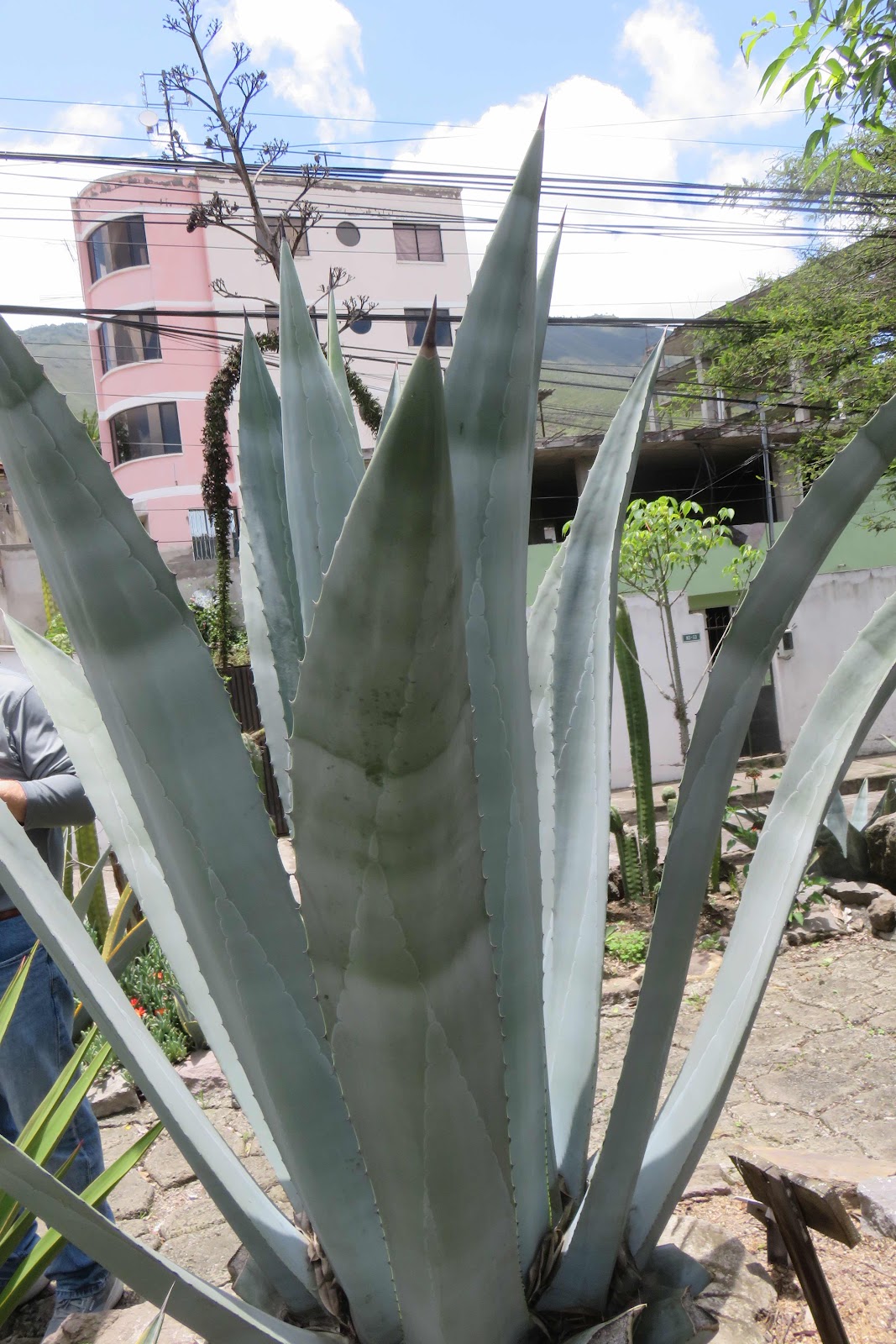
Casa Agave is a fairly new local industry which has resurrected the ancient art of gathering liquid from the agave plant and releasing its spirit! Our guide showed us different types of agave plants and their many uses.
We even held a cochineal beetle which infests different cacti,
and when crushed is used to create a beautiful natural maroon dye. Mixed with lemon juice, the dye become orange, and when baking soda is added, orange becomes purple.
Fibers from the plants’ leaves are used for hats, sandals, rope, and even paper. Approximately 10 liters of liquid a day is collected from the blue sword agave when the plants are around 10 years old and as they are really to bloom which will result in their natural death. Although this small company hopes to have an agave farm in the future, it currently has to finds these plants around the country to harvest the liquid! It is fermented, distilled, and part is aged in wooden oak barrels for another year.
A light lunch beautifully presented and tasty made sure we weren’t drinking on an empty stomach.
The resident Guinea pig keeps us company looking for handouts. Hint little piggy….don’t go to Peru, or they may eat you!

We enter the tasting room, and Diego, the company’s owner gives us a fun and informative talk about “ releasing the spirits” of the agave plant. “Mexico has tequila, but in Ecuador it is minke.”
We taste the agave sap, unprocessed liquid (sugar water), the green flower (like a pickle), and finally the good stuff which recently won the Best Spirit Award medal in California. We learn about using our senses…smell ( alcohol, fruit, and oak), sight (swirl and look for legs), and finally taste after a quick nip of pink Ecuadorian salt on your hand followed by a swig of lemon. Very smooth!
Ahhh, but the fun continues as we enter the bar to sample two different mixed cocktails made with miske. One resembles a mojito in a glass crusted with sugar and the other has anise and cinnamon sprinkled on top. Robyn takes a sip and hands me her drink so I got both. Another plus for traveling with a non-drinker!
I bought several small bottles for the boys, but they might get “lost”! Wink, wink!
A very short rest and off to Pichinchu, home of the tallest volcano in Quito at over 16,000’. A gondola takes you to the first observation area over greenery and a small dairy farm to almost 13,000’. Then it is up to you how high you want to hike to reach the summit. A 5-hour trip each way will reach the pinnacle, but I didn’t have the time nor the stamina. I hiked, breathed hard, rested, took pics,
hiked some more before finally heading back to the gondola as wispy clouds were rolling in. I need a few more days of high-altitude medication plus hauling around less weight to manage this volcano!

I did get pictures of the city below and the beautiful chapel.
Our guide selected a local Ecuadorian restaurant for dinner. Not only was I not hungry, I was tired and had to repack EVERYTHING to divide what to take to the Amazon rain forest for four days and what to leave in Quito for our return since we could only take a small bag. Smart decision as it took more than three hours to reorganize, repack, shower, and prepare for an early start tomorrow. Hasta luego!
Comments
Post a Comment