Day 3 - Into the Amazonian Rain Forest
FINALLY I felt rested and awake at 5 AM with luggage to be picked up at 6:15. As we head to the airport for a short 30 minute flight, Juan, our guide, teaches us more about Ecuador (derived from the word equator) and the Amazonian basin. Nine countries share the rain forest territory. Brazil once had the vast majority which has been greatly reduced over the years with deforestation. Ecuador has only 2%, but it represents 40% of the country!
When the Spanish conquistadors arrived in 1541 in present day Ecuador, they were looking for the legendary golden city of “El Dorado.” They conscripted indigenous natives to help 500 soldiers, horses, and even dogs to find this treasure. Along the way, natives were attacked and murdered. After 9 months of searching from Quito to Coca which today is a 30 minute flight, they found nothing!
The indigenous people fought back with spears, blow guns, and bows and arrows. Since Ecuadorian men wore their hair long, the conquistadors thought the warriors were the mythical Amazonian women. Thus, the region was named!
We arrive in Coca, a town on the Napo river which is the largest of the 1,100 tributaries of the Amazon with 40% in Ecuador and 50% in Peru. This is an oil town contributing to the production of 5,500 barrels daily. While Ecuador also exports roses, chocolate, shrimp, and bananas (Number 1 in the world), oil is Numero UNO. I believe I read that oil accounts for 40% of Ecuador’s GDP.
Before 1960s-1970s, the rain forest was not seen as a valuable resource. A national committee was established to develop the area, and 125 acres/family were available. The recipients had to use at least 60% of the land, but Ecuadorians are not good farmers. They are successful small family farmers but not large profitable enterprises.
When oil was discovered, the rain forest became a huge natural resource. However, it has also created a multitude of mixed feelings among Ecuadorians. Only 3% of the population is upper class, 65% middle class, and 24% is lower class. Oil has infused money into the economy but resulted in corruption in the government. Few jobs are offered to the indigenous people and these are usually non-skilled labor. While the population needs these jobs to support their families, they mourn the destruction of their rain forest.
Juan shows us local fish in the market…small mouth bass,
massive catfish (they can weigh up to 200 lbs but these are only about 150),

and piranhas!
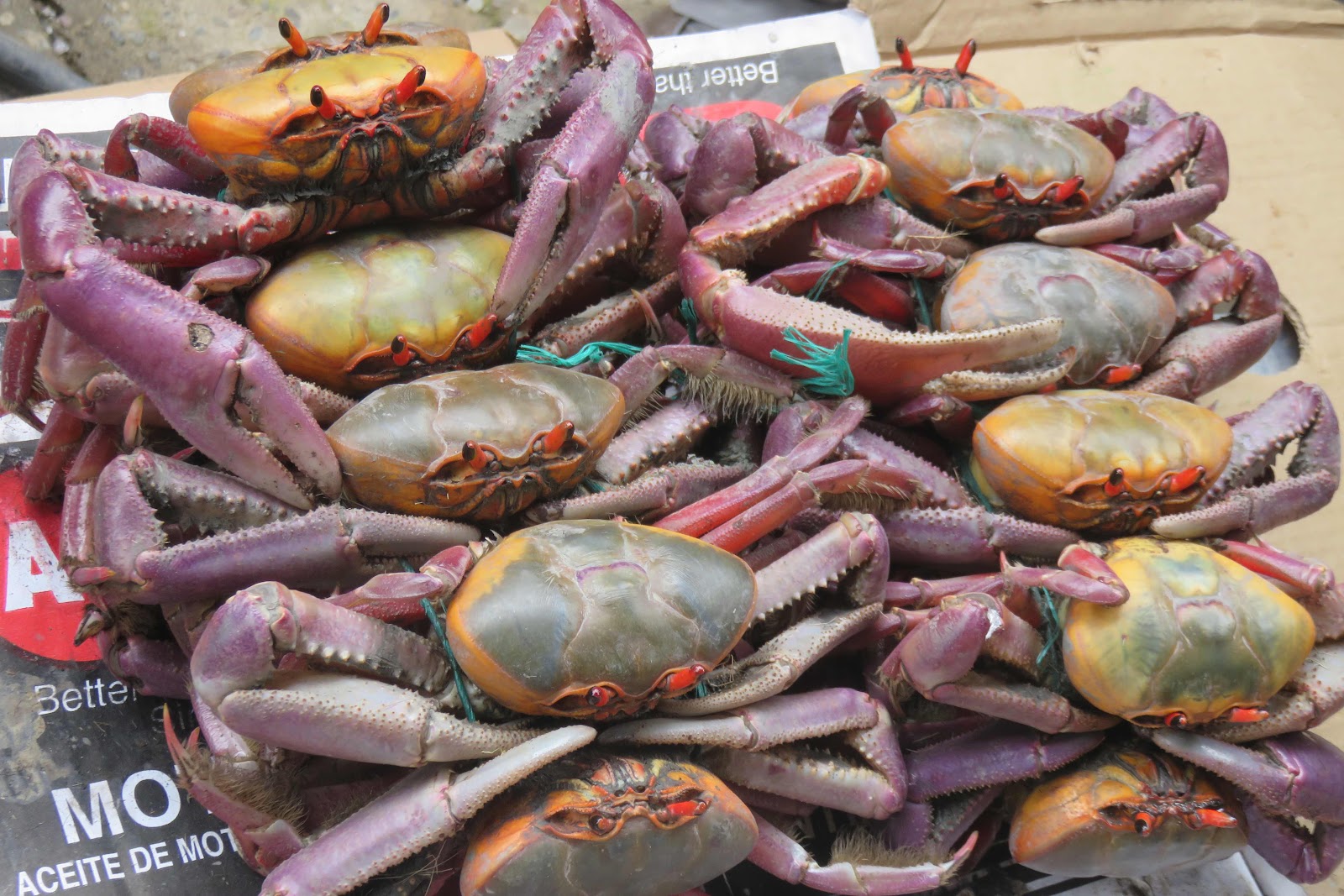
A dozen crabs are $15!
When he returns home from a guiding trip, Juan later tells me he always takes two piranhas for his wife to prepare for the family in a stew! He said it is a mild fish but lots of bones in some body areas. Wonder if we will have a chance to taste! Much better to eat them than the other way around!
The produce market has a colorful array of new sights, smells, and tastes.
We try the fruit of the guava tree…white, sweet and slightly fibrous with a big black seed,

and lichees fruit….beautiful outside and a great snack with a big seed also.
We visit a local naturalist with an assortment of remedies on a table to heal cuts, help sore backs, and all variety of ailments.

One of the couples in our group who arrived a day early for the tour had their bag stolen in Quito by a “friendly” pair of men helping to clean a green liquid off their jackets which they thought was bird poop. Fortunately, a policeman was nearby, and the thief dropped the bag! We were told to be very diligent with our possessions. I felt one man eyeing me in the market so I backed up to a wall and was prepared for battle!
Our motorized canoes await, and we climb aboard for an hour trip down the wide Napo River with a current running 3-6 miles/hour.
I am amazed at the different shades of green and the depth of foliage along the banks. We don’t see a lot of birds on the river which surprises me.
We see the sign for the Yarina Lodge, a rain forest ecotourism destination, on a creek off the Napo River.
The bamboo and thatched roof main building sits above the river banks where three meals a day are served, groups gather (ours is the only one here presently), schedules are posted, hammocks are available, and a bar serves cocktails!

First I have to get out of this canoe without falling into the water!

Lunch with fresh local ingredients is delicious, and our entertainment is monkeys enjoying some fresh bananas down below at the jungle’s edge.
Our rooms are assigned, and it’s time for a siesta. Most rooms are designed for at least two people with a pair of double beds, wood floors, private baths with hot and cold water, and a front porch with a hammock! This is glamping!

Our first walk to a nearby lagoon acclimates us to the jungle. Birds swoop and bird calls are everywhere. We see monkeys, and insects too numerous to name, fungi and plants both familiar and foreign. Only 10% of sunlight reaches the forest floor through the dense overhead canopy of thick foliage.
Juan seems to know every bird and insect and tree. He grew up in a small Ecuadorian community in the Amazon so he is completely at home. More about Juan’s amazing story later.
As the day closes, we go for another jungle visit, but this time in the last afternoon light across the river. The canoe glides along the waterway as we spot a multitude of birds and more monkeys. A common bird about the size of a chicken with reddish wings and a crest on his head is the Wilson.
A couple of vultures are eyeing us from a limb!

Everyone is hoping to see a sloth hanging from the next tree but no luck tonight.
We watch the sunset across the river as we head back to the lodge.
It is dark as we return but our guide spots a couple of katydids on a tree trunk,
and a big hairy tarantula (look at about 1:00) on the thatched roof of the boat ramp!
I can’t wait for a shower when we return to our cabins for the night. After half a day in the jungle, I am a sweaty mess! Pulling back the bed’s covers, there is a lightweight wool blanket. “Aren’t you optimistic!” as I toss it to the side.
The night sounds creates a natural relaxing rhythm since our room’s large double windows are open except for screens. Even the bathroom ceiling is only screened, but a thatched roof covers the entire cozy structure. The fan is blowing, I crawl under my mosquito netting, and I look forward to a peaceful night of slumber. Buenos noche!
Comments
Post a Comment